Collector Basics
Stamp Catalogue Numbers Explained
How Stanley Gibbons, Scott, MICHEL and Yvert numbers work — and how to search them accurately.
Last updated: July 2026
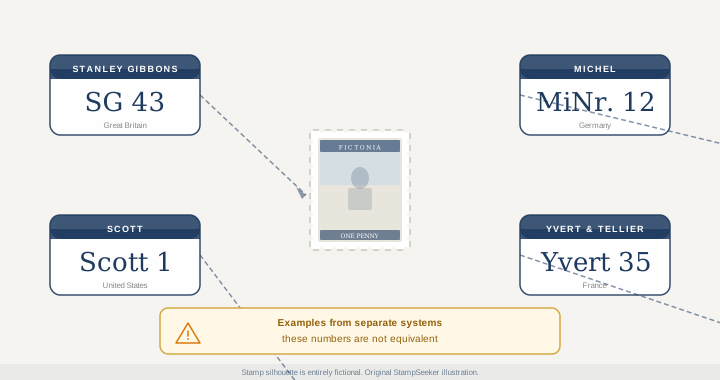
Catalogue numbers belong to separate publisher systems and must always be labelled. Original StampSeeker illustration.
A stamp catalogue number identifies an item within a particular publisher's catalogue. Stanley Gibbons, Scott, MICHEL and Yvert & Tellier maintain separate numbering systems. The same physical stamp may therefore have several different legitimate catalogue references.
Always state which catalogue system you are using. "Number 43" by itself is incomplete. "SG 43" identifies the reference system.
What a catalogue number does
- Gives collectors, dealers and auction houses a concise reference.
- Helps distinguish issues, denominations and listed varieties.
- Points to a full catalogue description that may include date, colour, watermark, perforation, paper and condition information.
- The number alone is not a complete identification.
- The catalogue edition and specialist volume may also matter.
The main catalogue families
Stanley Gibbons
- Widely used for Great Britain, Commonwealth and British Empire collecting.
- References are commonly written as SG followed by a number, such as SG 43.
- Specialised catalogues may list more varieties than simplified or general editions.
Scott
- Widely used in the United States and by many collectors of worldwide stamps.
- References are commonly written as Scott 1 or Scott #1.
- Letters, prefixes and suffixes may distinguish categories, major listings or minor varieties. Exact conventions must be checked in the relevant Scott catalogue.
MICHEL
- Widely used in Germany and much of continental Europe.
- References may be written as MICHEL, Michel, Mi. or MiNr.
- MICHEL publishes both general and specialised catalogues. Numbering and sub-listings must be read from the appropriate volume.
Yvert & Tellier
- Strongly associated with France and French-speaking philately.
- References may appear as Yvert 35, YT 35 or Y&T 35.
- Specialist and territorial catalogues provide the accompanying identification details.
Popularity of each system varies by country and collecting area. Use the catalogue most relevant to the stamps you collect.
Why the numbers do not match
Each publisher independently decides:
- which items receive a main number
- which varieties receive letters or sub-numbers
- how categories such as postage due, officials or air mail are organised
- when newly discovered or issued material is inserted
- how specialised differences are presented
SG 43 is not automatically Scott 43. Scott 1 is not automatically MICHEL 1. Two catalogues may group or separate varieties differently, and numbers may change between catalogue editions.
Prefixes, suffixes and sub-numbers
A catalogue reference may include a prefix, a capital or lowercase suffix, a decimal, slash or hyphen, or a range. These can indicate:
Rules vary between publishers. Never remove a letter or prefix when recording a reference.
How to record a catalogue reference
A complete record should include:
- Catalogue family
- Full number including prefix or suffix
- Country or territory
- Edition or year used
- Condition if relevant
- Notes about watermark, perforation or variety
Example
Stanley Gibbons SG 43, Great Britain, 2026 catalogueThis example shows recording format only — it is not a valuation claim.
How to search catalogue numbers
Sellers use many different forms for the same catalogue reference. Common formats include:
SG43SG 43S.G. 43Stanley Gibbons 43Scott 1Scott #1Scott No. 1Michel 12Mi 12MiNr. 12Yvert 35YT 35Yvert et Tellier 35StampSeeker already normalises common catalogue-number formats to improve marketplace recall.
Why a number alone can still be wrong
- Sellers can mistype catalogue numbers.
- A listing may use the wrong catalogue family.
- A simplified catalogue may omit a specialist difference.
- A stamp may have the right basic design but the wrong watermark or perforation.
- A number copied from an album page may be outdated or incorrect.
- Search results are evidence to investigate, not automatic confirmation.
Catalogue value is not market value
Catalogue values are reference figures produced under each publisher's stated assumptions. Actual selling prices can differ because of:
Marketplace asking prices are also not proof of realised value.
StampSeeker and catalogue numbers
StampSeeker uses catalogue-number search normalisation to make common formats easier to search across marketplace listings.
StampSeeker does not:
- assign official catalogue numbers
- guarantee that a seller's number is correct
- publish a cross-catalogue equivalence database
- replace the relevant catalogue
- guarantee catalogue or market value
Always confirm the full physical characteristics in an appropriate catalogue before assigning a catalogue reference.
Related guides
Frequently asked questions
What does SG mean on a stamp listing?
It normally indicates a Stanley Gibbons catalogue reference.
What does Scott mean?
It identifies a reference from the Scott catalogue system, widely used in the United States and for worldwide stamps.
Are SG and Scott numbers the same?
No. They are independent numbering systems and the same physical stamp may have different numbers in each.
What does the letter after a catalogue number mean?
It may identify a major listing, minor variety or another distinction, depending on the catalogue publisher's conventions.
Can I identify a stamp using only its catalogue number?
Only if the number is correct and the stamp matches the full catalogue description including watermark, perforation and other features.
Why do sellers quote several catalogue numbers?
They may be helping collectors who use different catalogue systems, since the same stamp can have a legitimate reference in each.
Does a catalogue value show what my stamp will sell for?
No. It is a reference value produced under the publisher's stated assumptions, not a guaranteed transaction price.